Daddy B. Nice's
New Album Reviews
CONTENTS
TUCKA, Love Rehab 3 and Greatest Hits Vol. 1, 7-20-26.....
MIKE CLARK JR., Feel Good Music, 7-1-26.....
BREEZE MRDO2MUCH, Country Boy Love Story/Blues, 6-13-26.....
DAVID SYLVESTER, Uranus in Gemini, 5-17-26.....
WEST LOVE, Reach: The Voice After The Storm, 4-14-26.....
AVAIL HOLLYWOOD, Grown Man Blues, 3-15-26.....
AL GREEN, To Love Somebody, 2-21-26.....
BIGG ROBB, Juke Joint Soul, 12-24-25.....
F.P.J., The Introduction, 10-26-25.....
MIKE CLARK JR., Keep On Steppin: Big Stepper Edition, 9-12-25.....
TUCKA, The Hit Nation Compilation, 8-21-25.....
FAT DADDY, Perfect, 7-27-25.....
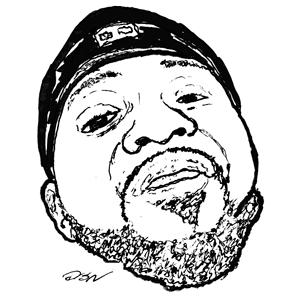 July 20, 2026:
TWIN TUCKA REVIEW: Love Rehab 3 and Greatest Hits Vol. 1 (Hit Nation Recordings/Create Music Group) Five Stars ***** Can't miss. Pure Southern Soul Heaven.
LOVE REHAB 3 Track List:
1. Do You
2. Tender Kisses
3. Wind For Me
4. Fly Me To The Moon
5. Do You Wanna Go
6. Push Up On It
7. In The Moment
8. Crazy Love
9. Drop Your Location
10. Do My Lil' Dance
11. Birds & The Bees
12. Shame On Me
13. Night On That Tequila (Remix)
Buy Tucka's new LOVE REHAB 3 at Apple.
GREATEST HITS VOL. 1 Track List:
1. 'Til The Sun Comes Up
2. Sweet Tooth
3. Big Train
4. Until The Morning Comes
5. The Rhythm Of My Guitar
6. Make Me Wanna Do Wrong
7. Love Doctor
8. Country Roads
9. Book Of Love
10. Touch Your Spot
11. Slow Rock
12. The Repair Man
13. Tipsy
14. Sweet Shop
15. Forever Swing (feat. Doug E. Fresh)
16. Blowing In The Wind
17. Appointments Only
18. Dancing With Fire
19. Move Something Remix (Part 2)
20. Carousel Of Love
Buy Tucka's new GREATEST HITS VOL. 1 at Apple.
They say that albums are passe'. Tucka evidently didn't get the message. What a boon that is for southern soul's fan base, because these two long-play projects---released only two weeks apart recently---hark back to the late-sixties' revival of independent artists releasing full-length, 33 rpm LP's to be played on turntables and broadcast over mostly college-town radio stations across America. The beautiful 12-inch album covers of that era no longer exist, but Tucka has brilliantly rediscovered and refined the ineffable experience of listening to music over large swaths of time---almost three hours in fact between these two digital discs---a feeling akin to launching yourself onto a king-sized bed and tuning out the rat race.
The late 50's and early 60's birthed a revolution in music created for a new market called "teenagers," who for the first time in history had money. The era was dominated by singles (45 rpm's) predominately put out by two sophisticated, machine-like, music-making meccas, one (Motown) in Detroit and the other (Gold Star Studios) in Los Angeles. These singles were consumed voraciously via "top-forty" radio stations, not that dissimilar from today's southern soul music scene with its YouTube and streaming services. Then along came
Bob Dylan, who despite being barely able to sing somehow defied the radio-programming gods who'd dictated a strict three-minute-max length required for airplay with his five-minute opus called
"Like A Rolling Stone". He not only succeeded but sparked a new era of indie musicians sophisticated enough to do their own music outside the predominant popular music factories, and the albums followed: a golden age of creativity and financial windfalls for indie artists that has never been seen since.
But the similarities with today's southern soul scene are striking. Once again, indie artists are on the rise. The big labels have died. Singles are the order of the day. The audience has lost the habit of buying music and the artists have gotten used to their little "pieces" of the pie in royalties. And here's Tucka putting out albums that have genuine value, that are entertaining, that have musical and thematic continuity, product that's varied but connected by a common musical thread, music that holds you enthralled for more than a couple of minutes.

If you go to my
artist rankings, you'll find that
King George and
Tucka have been ranked number one and two---neck and neck---at the top of the pyramid among southern soul creatives for some time now. King George represents the "singles"-generating side of the coin. I think a bunch of people had to wrestle him to the ground and twist his arms out of joint for him to even consent to putting out an album consolidating his cache of masterful, break-out singles. There have been some bootleg-related follow-ups which George has apparently brushed off like flies. Yet he still approaches his craft as strictly singles-based.
Tucka is doing something different. He's producing the singles, just as George does, but he's also looking at the long picture---that is, the pleasures of producing long-play work that people can listen to in relaxed and continuous chunks of time. These thoughts flooded over me as I listened to
Tucka's new LOVE REHAB 3. It's the best of the three LOVE REHAB albums by far. Masterful songwriting. Gorgeous string segments adding dimension and depth not only to individual tunes but tying the sequence together like beads of a rosary. Vocals demonstrating a maturation far beyond Tucka's early work.

I was surprised revisiting Tucka's first
Love Rehab album all the way back in 2009. I'd forgotten how tentative and derivative the debut disc was compared to the astronomical expectations his mature music sparks now, almost two decades later. He was coming out of zydeco (working for
Keith Frank). He shrugged off even being called a southern soul musician in those days. He wasn't trying to do zydeco, but he hadn't found his footing as "the king of swing" either.
Tucka found his groove on his next album,
Forever King, which introduced "Candy Land" and "Don't Make Me Beg" to a suddenly alert and curious southern soul fan base. And by the time
Love Rehab 2 (with "Sweet Shop," "Country Roads" and "Book Of Love") appeared, he had morphed into the King of Swing, a Pied Piper who could summon appreciative, adoring crowds at will with his melodic writing and disarmingly intimate vocals.
But even LOVE REHAB 2 seems like a preliminary step in the process of getting to where Tucka is today, basking in the mature brilliance of
Love Rehab 3. Not only is it chock full of stone-cold hits like this month's,
Daddy B. Nice #1 single,
"Do You," let alone previously released classics like "Fly Me To The Moon," "Night On That Tequila," "Do You Wanna Go," "Shame On Me" and trending, soon-to-be hit singles like "Push Up On It" and "Wind For Me". Yet as I hinted above, what's even more fantastic is that the totality of the album is more than the sum of its parts. What I found myself marveling with
Love Rehab 3 was the forgotten enjoyment of listening to an entire album of not only great songs---but songs which related to one another musically and thematically. It reminded me of the kind of prolonged happiness I once had reveling in
Marvin Gaye's "What's Going On,"
Stevie Wonder's "Songs In The Key Of Life" and
Michael Jackson's "Off The Wall," long-plays you can settle back and experience like a movie for the ears.
Tucka's career, it now seems evident, is an outlier among southern soul stars. The usual trajectory is brilliance in the beginning phase, a mid-career (shorter or longer) leveling-off and eventual decline.
King George is an example (minus the "decline" part, of course). His coming-out was revolutionary, like
Moses coming down the mountain to the Israelites with the 10 Commandments (the 10 Songs) in his hands, but there has been a leveling off, a coming-down-to-earth, you might say. Tucka is just the opposite. His graph line starts low and just keeps rising and rising in little jagged peaks (imagine an artificial intelligence stock this year) with the apex still to be determined.
Greatest Hits Vol. 1 (20th Anniversary Collection) adds largesse (almost two hours of music) to largesse (the one hour of music on Love Rehab 3). Full of Tucka standards---one here, one there---spanning the entirety of Tucka's catalog,
Greatest Hits avoids a strict, linear chronology of early hits only. It's as if Tucka is taking a light-hearted, intuitive approach to his oeuvre. So you encounter early tunes like "Sweet Shop," "Book Of Love" and "Forever Swing" (albeit the
Doug E. Fresh Remix) but also mid-to-later-era selections such as "Tipsy," "Big Train" and "Until The Morning Comes". There are so many songs, twenty in all, that the eras fade into one another and begin to create a kaleidoscope of dancing lights in front of your eyes. It's like falling out of a canoe in a rushing, white-water stream and tumbling through the current. The sheer magnitude and force of the accumulated sounds simultaneously disorients and excites you.
So yes. Releasing these two long-play albums simultaneously is an event to be cherished and celebrated and also a long time coming. Believe it or not, Tucka's last studio album, WORKING WITH THE FEELING, dropped eight years ago. (DBN notes: Tucka has apparently disowned his 2023 album THE GUY YOUR MAN CAN'T STAND. It's no longer available at commercial retailers, although copies can still be found on eBay.)
----Daddy B. Nice
Listen to all the tracks from Tucka's LOVE REHAB 3 on YouTube.
Listen to all the tracks from Tucka's Greatest Hits Vol. 1 (20th Anniversary Collection) on YouTube.
Buy Tucka's LOVE REHAB 3 album at Apple.
Buy Tucka's Greatest Hits Vol. 1 (20th Anniversary Collection) at Apple.
Read Daddy B. Nice's 21st Century Artist Guide to Tucka.
Read Daddy B. Nice's The New Generation Artist Guide to Tucka.
************

Send product to:
SouthernSoulRnB.com
P.O. Box 19574
Boulder, Colorado 80308
Or e-Mail: daddybnice@southernsoulrnb.com
*************
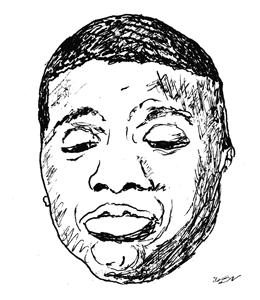 July 1, 2026:
MIKE CLARK JR.: Feel Good Music EP (ColliPark Music)
Five Stars ***** Can't miss. Pure Southern Soul Heaven. Buy Mike Clark Jr.'s new FEEL GOOD MUSIC EP at Apple.
FEEL GOOD MUSIC Track List:
1. Used Car
2. Don't Play With Me
3. Straddle Me
4. No Chaser (feat. K. Camp)
5. Proud Of Me
6. Don't Stand Next To Me
7. Cups In The Air
For such a small project Mike Clark Jr.'s Feel Good Music packs a hell of a wallop. Coming as it does on the heels of Clark's ground-breaking, career-commencing, long-play masterpiece,
Keep On Steppin: Big Stepper Edition, reviewed here less than a year ago and still posted on this page, one might expect a drop-off in quality, but that's not the case. The material and execution are as good if not better.
The opening three tracks alone transpire like a sequence of top ten singles---which they are actually.
"Straddle Me" charted at
#4 in May, "Used Car" charted at
#8 in July, and
"Don't Play With Me," ensconced in the low teens in Daddy B. Nice's Top 40 Singles for July and rapidly climbing, is slated for Top 10 Singles in August.
"Used Car" in particular fires me up. Just a beautiful melody, made more enticing by its delicacy and modesty, "Used Car" features a vocal by Mike that not only recalls great soul singers of lore. It's so universal it wouldn't be out of place on an early Beatles album with John Lennon on lead vocal. It's the antithesis of the one-dimensional, faux-blues screaming that "artists" currently streaming in the artificial intelligence industry mistakenly believe is the height of southern soul authenticity. The tender touch has been a staple of soul music since the heyday of Berry Gordy, Smokey Robinson and Motown, where artists were coached to hold back a little, making the records (paradoxically) even more powerful and effective. The deft touch is something
"Used Car" shares with
"Don't Play With Me". Only beginning to gain airplay as I write, this duet with an uncredited female co-vocalist showcases Clark Jr.'s vocal skills and range, which are maturing with astonishing proficiency.
The climax of the EP comes, fittingly, at the end with
"Cups In The Air," an HBCU-sounding anthem that will undoubtedly provide the soundtrack for countless football games this fall. It was the first single release from
Feel Good Music and another
top ten-charter in January, ample time for it to have accrued over a million enthusiastic YouTube views.
"If the ocean was liquor" (Mike sings),
"And I was a duck,
I'd swim to the bottom,
And drink my way up."
For Clark Jr. partisans, that leaves only
"No Chaser," "Proud Of Me" and
"Don't Stand Next To Me" as relative unknowns, still waiting to be exposed on streaming sites and social media.
By the high bar set by Clark Jr. throughout the EP,
"Proud Of Me" is arguably the least effective.
"No Chaser," however, is another contemplative riff on romantic love, winsome and engaging, and further enhanced by a well-done rapping interlude by K. Camp. And albeit not in the league with Clark's signature classic
"Keep On Steppin'," "Don't Stand Next To Me" is a lot of fun both musically and lyrically, offering a refreshing contrast (along with "Cups In The Air") to the romantic themes dominating the album.
Feel Good Music captures Mike Clark Jr. successfully moving on from his bombastic entrance into southern soul with the thrilling, high-energy hits "Auntie Outside Tonight" and "Keep On Steppin'"---never an easy thing for a young artist to do. And just as those blockbusters assured Mike Clark Jr.'s debut, this follow-up---think of it as a breather---presents the more gentle, sweet, and love-oriented side of the young southern soul star.
---Daddy B. Nice
Listen to all the tracks from Mike Clark Jr.'s Feel Good Music EP on YouTube.
Listen to Mike Clark Jr.'s Feel Good Music EP on Spotify.
Read Daddy B. Nice's Artist Guide to Mike Clark Jr.
Mike Clark Jr.'s new Feel Good Music EP at Apple.
************
Send product to:
SouthernSoulRnB.com
P.O. Box 19574
Boulder, Colorado 80308
Or e-Mail: daddybnice@southernsoulrnb.com
*************
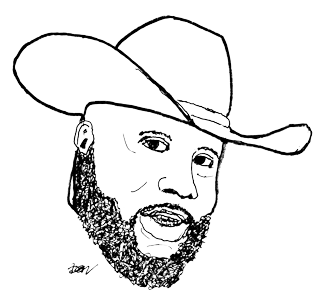 June 13, 2026:
COUNTRY BOY LOVE STORY/BLUES Track List:
1. Breeze (Intro)
2. Grown Man Shit
3. Right Your Wrongs
4. I Found A Woman
5. Love Me For Real
6. Be Careful
7. What A Country Boy Do
8. Don't Want To Be Kept
9. MrDo2Much (Intro)
10. Country Boy Blues
11. A Horse To Ride (feat. Jeter Jones)
12. Step On
13. Can I Come Home
14. Unk Talk
15. Stepping Boots
16. Give Em Sum To Think About
17. Outro
Like his colleague Big Mel, Breeze MrDo2Much is a big, chesty, offensive lineman-sized fella with a surprisingly keen and reedy tenor, a denizen of the very central Mississippi hamlets around Jackson, Mississippi where I hunkered down and picked up my love for southern soul in the nineties and aughts. When these guys proclaim they're country boys they're not kidding. Breeze himself caught the southern soul bug professionally in the early 2020's.
Country Boy Love Story/Blues is his third long-play, southern soul album in four years, following two commendable predecessors,
Before Country Was Cool and
The Chocolate Cowboy. What makes
Country Boy Love Story seem like a debut is the fact that no one had heard of Breeze until he recorded the
award-winning ballad
"Love Me For Real". This anthem to grown-folks love is a throwback blockbuster delivered with the conviction of a pancake block. I devote an entire tribute to
"Love Me For Real," the song and its significance, in the
Daddy B. Nice's Artist Guide, so I won't take up any more space here. Readers can click the link. And with a steadily rising thirteen million views on YouTube, the fans seem to agree. It's the undisputed anchor of this sprawling and deserving seventeen-track set.
Having said that, I think even Breeze was surprised when I praised his single
"Can I Come Home?" in March of this year, but it was for the same reasons that I appreciated "Love Me For Real". "Love Me For Real captured the classic southern sound---mid-tempo, modest, earthy, sincere---of the aughts and teens. In a parallel way the hilarious "Can I Come Home" rediscovered and redid one of the authentic cultural tropes of southern soul.
If you love the blues---the great "talking" blues of Bobby Rush, Billy "Soul" Bonds, Marvin Sease and Latimore---(I wrote)---
this song will knock...you...out! Truthfully, I didn't know Breeze had it in him, and I'm ready to fall to my knees and bow all the way to the floor. Talk it, Breeze, talk it! I haven't heard a monologue this good since LaMorris William's "Impala".
And yet Breeze must have been even more taken aback the following month when I elevated
"A Horse To Ride" to the status of #1 Southern Soul Single, an accomplishment that despite its eventual
Best Ballad of The Year award "Love Me For Real had never achieved. In my commentary for "(Every Cowboy Needs) A Horse To Ride" I described
trying to figure out if you need to get high to realize what a great song this is. Or could be. All I know is that with a swig or a puff...those long, lazy spaces in the instrumental track light up like strobe-pulsing invitations to dance. Well, Breeze took care of that in the blink of an eye, bringing in
Jeter Jones (who'd accompanied him two years earlier on
"Don't Play Wit It"), to juice up those "long lazy spaces". The remix is
captured here in all its club-jam glory. You can't play it too loud.
In its romanticism and melodic emphasis---and at the risk of jinxing it---
"I Found A Woman" appears to be this album's follow-up to "Love Me For Real". Recorded a year ago, with the same tempo and subject as "Love Me For Real," it too has accrued a respectable half-million views.
But it was the stepping songs on the album (in addition to "A Horse To Ride Remix") that garnered MrDo2Much an envy-inducing
three selections in the top fifteen spots of Daddy B. Nice's latest
Top 40 Singles (June 26).
"Step On" boasts funny lyrics over a stepping beat that even by stepping-song standards pulls you like nails to a magnet.
I'm a big dog, (Breeze brags),
You see me when I'm stepping through.
I'm a big dog,
They said she's gonna cut me loose.
The nonchalance with which Breeze considers the impending break-up would be infuriating if you took it seriously. Like him, you don't. Hey. It's life in the playa's lane. You just "step on".
"Stepping Boots," by contrast, is an invitation to the dance floor---nothing more, nothing less. It's all about the hook. Like a Pied Piper, Breeze is especially good at making the simple things in life enjoyable.
I found
"Country Boy Blues" fascinating, although at a little more than a minute and a half in length it's not much more than a sample. There's some funk in the beat and Breeze's vocal, typically guy-next-door and cajoling, has a different tone, as if he were addressing a big audience. It jumps out of the pack, and what a pack of material it is. I haven't even addressed songs like "Unk Talk," "Give Em Sum To Talk About," "What A Country Boy Do," "Right Your Wrongs," "Grown Man Shit" and more.
Breeze MrDo2Much is a hard-working artist. You have to be to thrive in southern soul's competitive market, and I'm constantly puzzled by how many recording artists are content to record a song and sit back and relax, then wonder why that project isn't carrying them to the promised land. Breeze is already ahead of the game. He's talented, he does a number of things well, and most importantly he creates product with phenomenal drive and ardor.
Country Boy Love Story/Blues marks his coming of age.
By the way, I'm the one who "outed" the previously anonymous West Love as Kelsie West. Now she and her fans appear perfectly comfortable with it. Breeze MrDo2Much (what a moniker!) has also gone this far professionally without publishing his real name. Just as I did with West Love/Kelsie West, I'm going to guess that Breeze MrDo2Much's real name is Harvey Brown. Alert to the internet gods. I haven't confirmed it. I don't know for sure yet. But that's my educated guess.
---Daddy B. Nice
Listen to all the tracks from Breeze MrDo2Much's Country Boy Love Story/Blues album on YouTube.
Listen to Breeze MrDo2Much's Country Boy Love Story/Blues album on Spotify.
Read Daddy B. Nice's Artist Guide to Breeze MrDo2Much.
Buy Breeze MrDo2Much's new Country Boy Love Story/Blues album at Apple.
************
Send product to:
SouthernSoulRnB.com
P.O. Box 19574
Boulder, Colorado 80308
Or e-Mail: daddybnice@southernsoulrnb.com
*************
 May 17, 2026:
DAVID SYLVESTER: Uranus in Gemini (2026 IVR)
Four Stars **** Distinguished Effort By A New Southern Soul Artist.
Buy David Sylvester's new URANUS IN GEMINI album at Apple.
URANUS IN GEMINI Track List:
1. Shapeshifter
2. Louisiana Lovin'
3. I'm Talkin' Bout You
4. Good Times (feat. Kim McCoy)
5. Happy Birthday
6. Tonight
7. Magic Show
8. Hear My Heart
9. Just Like You
10. I Will
11. Solo Guy
12. Love (feat. Nick Sedita)
13. Home
14. Pharisees
He's just getting his toes wet in the genre, but it's not a stretch to say Opelousas, Louisiana native David Sylvester already possesses the richest baritone heard in southern soul since the emergence of
King George. The problem is that while competent, his
prior catalog might have been forged in any region of the country. It's a smoother R&B, lacking the immediacy and cultural profanity of southern soul. Sylvester also hews to the one-man-and-a-mike format of singer/songwriters going all the way back to James Taylor's
"I've Seen Fire And I've Seen Rain". No offense to his already enthusiastic Gulf Coast followers, but these stylistic traits make David a questionable star for the wild and gritty fans of contemporary southern soul
But then there is the talent. The undeniable power of the man's vocals and songwriting. The magical stuff that crosses all boundaries. Yes, Sylvester could as easily drift into straight urban rhythm and blues. Witness
"Good Times" with Kim McCoy or
"Tonight". And yet...when he infuses his vocals with that husky, furry tone, self-respecting southern soul heads swivel in astonishment, immediately recognizing the raw material dreams are made of. Whether Sylvester pursues a southern soul path is anyone's guess, but
Uranus In Gemini, his oddly-titled new album running 48 content-heavy minutes, features---for starters---the two songs that circulated like hot blood through the chitlin' circuit late last year.
The first was
"Louisiana Lovin". The tune starts with a modest premonition of its chorus---guitar, harmonica and that husky, head-turning baritone humming the melody. Right away you're entranced. Then come the lyrics:
"I've been thinking about you for awhile now,
See I heard that you asked somebody,
And I almost threw in the towel..."
What David means is "I heard that you asked somebody ABOUT ME". And "I almost threw in the towel" means that he'd almost given up pursuing her. Immediately he's seized your attention. And you know it's going to be good. That handful of words has you salivating for tidings of good love, and before you know it you're transported into the story's heart:
"I don't need no Tennessee whiskey, whiskey in a jar.
Don't you give me no gin and juice.
Can't buy no loving at the bar.
'Cause I'm already drunk off your kissing and hugging.
All I need is your Louisiana lovin'."
This is the song that won over the chitlin' circuit, grafting traditional southern culture (drinking "Tennessee whiskey") onto a first-class piece of songwriting, not to mention echoing the much covered and imitated
country-western classic by Chris Stapleton. That's really important, because if David Sylvester has a "fault" in terms of marketability, it's that he's not sufficiently formulaic in the southern soul sense. He's not the kind of artist who's going to salt his tunes with tropes from popular southern soul standards. In this case he did, and it was a hit.
Then came
"Magic Show". Bring out the velvet rope and red carpet, please. "Magic Show" has none of the traits that benefited "Louisiana Lovin'". It utilizes a pure singer/songwriter approach and contains no musical nor lyrical historical touchstones. In truth, the absence of any recognizable tropes or formulas kept it on the down-low for even the most perceptive southern soul audience. What
"Magic Show" does have, however, is undeniable truth and beauty.
I was fascinated with the tune from the outset. I didn't know exactly what kept pulling me toward it, and I sure as hell didn't know what was going on in the lyrics. What I did know was that it had a competent and even unique melody, an understated but charismatic instrumental track and a masterful vocal. But at last the little light bulb turned on: I'd never heard lyrics of such intricacy and sophistication in a southern soul song.
Listen:
"I've been under your spell," (Sylvester sings as a guitar and organ gently jog in the background)
"Since the moment you laid your lips on me.
And I know that you can tell
Is the only reason I put up with your trickery.
All your smoke and mirrors making a fool of me.
Just when I let down my guard
You disappear right before my eyes.
With just my luck, when it comes to you,
I'm still hypnotized.
Why? I don't know but I ain't leaving this magic show."
It gets even better, slowly ascending to a verbal climax so poetic and Rubik Cube-mystifying I never fail to nod my head in a kind of rapture of appreciation:
"You gave me a front row seat to all these fantasies.
Then you pulled out the rug right from under me.
Locked me in a box of expectations
And called it loving me..."
That last couplet is a killer. And finally:
"...But as long as I'm breathing I'm feeling you.
As long as my heart is beating it'll be for you.
All I know is I ain't leaving this magic show."
"Louisiana Lovin" ("I don't need no Tennessee whiskey, whiskey in a jar...") and
"Magic Show" ("Just when I let down my guard/You disappear right before my eyes") debuted on Daddy B. Nice's
Top 10 Singles Chart in December of 2025. Only a month later, the pair was enshrined (at #11 and #19) in Daddy B. Nice's
Top 25 Songs Of The Year. And now, a mere four months later, Sylvester drops not only this pair of singles but another dozen tracks of all new material. No filler. This is not the modus operandi of a journeyman. This is the sweat and genius of a potential star in the making.
The set is a showcase of love songs. David Sylvester has a muse or he couldn't write songs like this. It's clear he's in love. Or has been in love. Deeply. Recently. Who doesn't want to hear from such an ambitious artist with so much to say about the emotions that fixate us all? I only regret time and space doesn't allow delving into more of these interesting tracks in
Uranus In Gemini, among them but by no means limited to:
"Shapeshifter" (the title tune striving to be another "Magic Show"...)
"I'm Talkin Bout You" (another lovely nod at southern soul formulas but I can't put my finger on the original source....)
"Solo Guy" (so personal, so introspective...."All these years of me, myself and I/Turned me into a solo guy....")
"Hear My Heart" (a surefire, charting single..."Are you listening?"...)
"Love" (starts with idiosyncratic percussion like a drumstick tapping on a wood block clacking out an off-kilter groove...and when he says, "I could really use some love right now," it's plain he's not just a starry-eyed, innocent romantic; he's a 'solo guy' in need of intimacy, flesh....)
"Pharisees" ("In the bars and clubs people smiling and loving one another/But in the church-house people walking around with attitude....").
It's a huge set. Chances are you won't like everything. But just when you hit something a little vanilla, it's followed by something redeemingly piquant. And like "Magic Show," you'll be thinking...
"God, he must have a hell of a woman!"
---Daddy B. Nice
Listen to all the tracks from David Sylvester's "Uranus In Gemini" album on YouTube.
Read Daddy B. Nice's Artist Guide to David Sylvester.
Buy David Sylvester's new URANUS IN GEMINI album at Apple.
************
Send product to:
SouthernSoulRnB.com
P.O. Box 19574
Boulder, Colorado 80308
Or e-Mail: daddybnice@southernsoulrnb.com
*************
 April 14, 2026:
WEST LOVE: Reach: The Voice After The Storm (2026 Kelsie West) Five Stars ***** Can't miss. Pure Southern Soul heaven.
Buy West Love's new REACH: THE VOICE AFTER THE STORM album at Apple.
REACH: THE VOICE AFTER THE STORM Track List:
1. Reach
2. Keep Pushing
3. At The Altar
4. All I Need
5. Mighty Good God
6. No Negativity
7. Nobody
8. Walk With Me
9. Won
10. Been Good
Don't consider this a "Christian" only album. Approach it as if it were straddling the fence between gospel and southern soul. Ardent fans of West Love will have no problem with that. Read the comments section on the YouTube page for the title track,
"Reach," first published three years ago. From Sam Cooke to Vick Allen, blues singers have by and large been gospel singers, kids who grew up singing in church. Yes, there are formulas, mannerisms, inflections, vocal and instrumental, that distinguish the religious from the secular genres, but without church music there would be no secular music. No black music, no race music, no blues, no rhythm and blues, no southern soul. And without Kelsie West, there would be no West Love.
I encountered the precursor to West Love's new album
REACH: THE VOICE AFTER THE STORM a couple of years ago on YouTube as part of a newly-posted, ten-minute-long, inspirational, two-song mash-up entitled
"Reach" and "Keep Pushing" and was so impressed I resolved to recommend it not only to fans but to West Love for commercial release. Then, while looking for an alternative YouTube link for publication, I discovered a
"Keep Pushing" video released by one Kelsie West five years before she became famous as West Love---a self-fulfilling classic if ever there was one!
These two heart-rending ballads,
"Reach" and
"Keep Pushing"---the former a chilling account of a soul floundering in the depths of despair, the latter a motivational sermon any coach of a despondent collegiate team would be thrilled to deliver at halftime---constitute the first two tracks of this amazing album. As impeccably written and performed as they are, however, I would not recommend
REACH to the good-times-seeking sensualists of southern soul music if another pair of monstrous singles---
"Won" and
"Been Good"---didn't bookend this sublime set at its close.
These are fast-tempo tunes. Clocking in at a svelte three minutes, the rhythm track-driven
"Won (Again)" may take you all the way back to Ike & Tina Turner's rendition of Creedence Clearwater Revival's "Proud Mary". So focused is West Love on the thigh-thumping instrumental background, her vocal seems to slur throughout from "won again" to "born again," and the last three words I hear at the song's conclusion are "You are asinine." If the great (and religiously devoted)
Peggy Scott-Adams were still available, she'd undoubtedly correct me on that and reveal the words' true meaning.
"(God's) Been Good," on the other hand, is arguably over-long at four and a half minutes (four might have been enough), but in all other respects it is the feature performance of the album. Couldn't be better. Bitching instrumental track. Celestial lead vocal. Wild, joyous chorus. I don't know about you, but I can dance to this. This is church taken to the club, and any southern soul-er who can't get into this is an imposter. My fantasy is to see "God's Been Good" morph into a secular club favorite, with dancers waving their hands in the air and testifying to "Jesus!"
I'm not suggesting secular fans will like everything about
REACH: THE VOICE AFTER THE STORM. But what's not to like about
"Mighty Good God," a retitling and repackaging of West Love's former, million-streaming single
"Mighty Good Man"? Or if, like me, your favorite funky soul music of the seventies was reggae, the impressively genuine
"No Negativity"? Searching for a love song that makes the competition sound smarmy? Try
"Nobody". Need an incredible new tune that fits any format? Check out
"Walk With Me". And there is much more. For that we have West Love, the secular flowering of Kelsie West, to thank.
Southern soul's big musical tent is always at its most vibrant when it welcomes outside influences---Dylan's long and anthemic "Like A Rolling Stone" inspiring Cooke's long and anthemic "A Change Is Gonna Come," or Belafonte's Caribbean swing gently influencing Sam's teenage-dreamy "Having A Party". No outside influence is greater---nor deserves more access---than gospel. The more you listen to this album, the more essential and gratifying as a southern soul showcase it becomes.
---Daddy B. Nice
Listen to all the tracks from West Love's "Reach: The Voice After The Storm" album on YouTube.
Read Daddy B. Nice's Artist Guide to West Love.
Buy West Love's new REACH: THE VOICE AFTER THE STORM album at Apple.
************
Send product to:
SouthernSoulRnB.com
P.O. Box 19574
Boulder, Colorado 80308
Or e-Mail: daddybnice@southernsoulrnb.com
*************
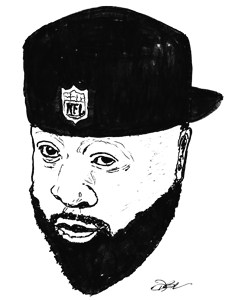 March 15, 2026:
AVAIL HOLLYWOOD: Grown Man Blues (2026 Avail Hollywood)
Four Stars **** Distinguished Effort. Should please old fans and gain new.
Buy Avail Hollywood's new GROWN MAN BLUES album at Apple.
GROWN MAN BLUES Track List:
1. Turn A Good Woman Bad
2. Stroking In The Woods
3. Savage (Grown Folk Pleasure)
4. Pulled A Me On Me
5. In The Truck
6. Poe Up With Me
7. That BS
8. The Same Color
9. Turn A Good Woman Bad (Alternate Mix) feat. Big Mama
Some people swear by Chevy trucks. Ford series trucks always have their fans. But no full-size American pickup has quite the cachet of the Dodge Ram. Just ask me. I bought my first one in 2001 and still have it. And
Avail Hollywood? Well, let's just say that
"In The Truck," the dominant single from his new album
Grown Man Blues, mentions "Dodge Ram" so often Ram Trucks ought to use it as a TV commercial. So I had a little fun when the single dropped, charting it in January's
Top 10 Singles.
Leave it to Avail Hollywood to best me in every way, I wrote,
dissing my most prized possession, a murdered---that means all chrome removed and customized---
all-black 1500 Dodge Ram with tires so big they cry out in agony when I make tight turns, with Avail's new---and comparatively monstrous---
3500(!) black Dodge Ram (who can afford that?) to while away the hours when he's not in the gym lifting weights so heavy they'd crush my skinny-armed writer's ass. Plus...Making it in the truck! Some people have all the fun.
So you can imagine my surprise in early March when I asked Avail (aka Christopher Estell) to send me the credits to the new album. After all, I'd just finished reviewing
Al Green's TO LOVE SOMEBODY EP with its exhaustive list of contributors from "vocal editing producers" to "string engineers". By that time I was impressed not only with the overall, ruminative beauty of the songs in
Grown Man Blues but its production, from the crisp, clean mix to the fine rhythm section and tasty lead guitar accompaniments. As much as I'd liked (and feted) Avail's recent collaborations with
DJ Trac, this seemed like a step up.
You know the funny thing about that record man, Avail replied.
I recorded that whole record in my RV I bought last year 2025, LOL! The world of digital mixing is so much easier now man, it took seven days, and 2 days to Master it, I made a post about it on facebook, and people thought i was joking until I posted the vid.
For those unfamiliar with Avail Hollywood, he's a solid and seasoned southern soul artist, less hyped and peripatetic than some, but currently ranked at a lofty #11 in Daddy B. Nice's current chart
The New Generation. Avail has a unique, hard-to-describe vocal aptitude---a sound like crying, only he isn't---and that echo of "crying" combined with a tremolo effect attached to his notes is the badge to his personal "blues" or "soul". There's not a bad track on
Grown Man Blues, and the facility with which Hollywood put the album together testifies not only to the quality of the songs but his abily to give them their best forms.
Among my favorites is
"Poe Up With Me". Lyrically, "If I get drunk/Someone take me home" recalls Bigg Robb's "If I Get Drunk Tonight" while "Drink, poe up with me" hearkens back to FPJ's "Pour Me Up Some More". Yet it's not at all derivative. Just the opposite.
"Stroking In The Woods" has a zesty guitar lick that reminds me of Robbie Robertson's picking back in the day with The Band, which affected how just about everyone has played guitar since. Maybe---probably--- it too has been absorbed into the new digital magic. And both
"The Same Color" and
"Turn A Good Woman Bad" (given a refreshing female remix featuring Big Mama at set's end) explore marital discontent with Hollywood's usual "grown folks" touch.
Speaking of "discontent," I don't even want to know if Avail Hollywood has both a 3500 Black Ram AND a new RV. It's a lose-lose. If he does, I'll feel even more inadequate and covetous. If he doesn't, I'll be red-faced and guilty of confusing art (specifically lyrics, more specifically owning a Dodge Ram) with autobiographical reality, the very thing I was lecturing Marcellus The Singer and his fans about in this month's
Top 10 Singles.
---Daddy B. Nice.
Buy GROWN MAN BLUES at Apple.
Read Daddy B. Nice's Artist Guide to Avail Hollywood.
Check out the many website citations and awards for Avail Hollywood since 2011 in Daddy B. Nice's Comprehensive Index.
Listen to all the tracks from Avail Hollywood's GROWN MAN BLUES on YouTube.
************
Send product to:
SouthernSoulRnB.com
P.O. Box 19574
Boulder, Colorado 80308
Or e-Mail: daddybnice@southernsoulrnb.com
*************
 February 20, 2026:
AL GREEN: To Love Somebody EP (2026 Fat Possum Records)
Five Stars ***** Can't miss. Pure Southern Soul heaven.
Buy Al Green's new TO LOVE SOMEBODY EP at Apple.
TO LOVE SOMEBODY EP Track List:
1. To Love Somebody
2. Perfect Day (feat. Raye)
3. I Found A Reason
4. Everybody Hurts
Let me set the stage for this review by relating a memory from my New York City days. This was early nineties, I'd guess. I was walking through Soho returning home from a club around two am. I saw a couple standing in front of a storefront ahead but didn’t cross the street as I sometimes did that time of night, since I was almost upon them and they looked safe and absorbed in their own thing. The guy was in jeans, boots and sport coat and the woman looked similarly hip, and as I passed I was struck by their gravitas. Then I was past them homeward bound and I realized it was
Lou Reed and
Laurie Anderson, the king and queen of Downtown, and I smiled to myself and thought, "All's right with the world."
Flash forward three decades. Despite his rock-solid, mainstream fame,
Al Green has been the most neglected of southern soul's baby-boomer generation, having disappeared down the rabbit-hole of gospel since his early-seventies' masterpieces with
Willie Mitchell at Hi Records in Memphis. But you don't have to be a nostalgia-hooked auntie to appreciate the cutting-edge force of
TO LOVE SOMEBODY, an unforeseen bombshell of an EP combining Green's vocal grit and brilliance with state-of-the-art production that hasn't been seen since his early-seventies' heyday.
To Love Somebody reminds us of how much studio money went into the great 20th century soul tracks and, sadly, how much was lost with their demise. But it's also a stark reminder in this age in which politics and culture are broken into micro-societies---and music into islands twixt never the twain shall meet---that white counter-culture was once umbilically connected to black culture (from which it derived its inspiration) and vice versa. So what is still second nature to Al Green, in this case covering songs made famous by white singers and songwriters---the late
Lou Reed & The Velvet Underground, The Bee Gees, R.E.M.---is by today's standards a revelation.
This quartet of songs is as deep and serious as you can get. When Green sings,
"I found a reason for living," he's doing so from a perspective, hopefully, most of us have been spared: highs of hyper-sensitivity and depths of despair. Both Green and Lou Reed struggled with heroin addiction, and Reed's words (from his early days with
The Velvet Underground) mesh perfectly with Green's hyper-vulnerability and preoccupation with mortality. Reed's
"Perfect Day," from his signature album
"Walk On The Wild Side," is interpreted quite accurately by Green (assisted by young British wunderkind Raye) as a moment of joy balancing precariously on a razor's edge of dread. And
"Everybody Hurts, taken from "R.E.M.'s
anti-suicide anthem of the same name, makes the existential foreboding almost unbearable. In contrast, Green's treatment of
"To Love Somebody," a cover of the
The Bee Gees' late-sixties' hit, seems almost giddy with gratitude, a respite of happiness in a world where the innocent and vulnerable survive only in glimpses.
With Al Green's new
TO LOVE SOMEBODY EP we're a long way from the tipsy, happy-go-lucky southern soul of "Wave your hands in the air / Like you just don't care." And musically we're in a gothic cathedral, not a shotgun house-turned-chapel. Al Green's psyche couldn't be distilled with any more purity. This quartet of songs proclaims, "All's right with the world." And if your preacher's sermons are getting a little dry, listen to this on Sunday morning. Al has found a reason for living.
Listen to all the tracks from Al Green's TO LOVE SOMEBODY on YouTube.
************
Send product to:
SouthernSoulRnB.com
P.O. Box 19574
Boulder, Colorado 80308
Or e-Mail:
daddybnice@southernsoulrnb.com
*************
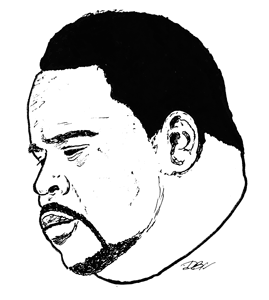 December 24, 2025:
BIGG ROBB: Juke Joint Soul (2025 Bigg Robb)
Four Stars **** Distinguished Effort. Should please old fans and gain new.
Buy Bigg Robb's new JUKE JOINT SOUL album at Apple.
JUKE JOINT SOUL Track List:
1. Do It Bigg
2. Ol' Heads
3. One More Drink
4. Tell On Myself
5. Don't Change Your Stroke
6. Juke Joint
7. We Like To Party (Jeri Curl Mix)
8. Country Love / Computer Love Medley
9. Slip Away (Mr. 808SoulMix Remix)
10. Get Sexy (Go-Go Mix)
11. Let's Get Away (Country Remix)
12. Good Guys
13. My Baby (Daddy's Love)
14. Dear Lord
15. Young Folks Love The Blues
16. On A Sunday (Stepper's Groove)
17. My Hat My Boots (Mr. 808SoulMusicRemix)
There's a couple ways of regarding this abundant set by one of southern soul's most unlikely yet heralded
"Ol' Heads," as Bigg Robb fashions himself in the tune of the same title---one of the best cuts, by the way, from
Juke Joint Soul. "50 years is the new 35," Bigg Robb proclaims. So does that make Daddy B. Nice, who was "daddy" to Ohio-born boys like Robb and Sir Charles Jones, the new "grand-daddy" to the young guard who are going viral with such frequency I can't remember to review the albums (like this one) by the old guard?
Here's the other way to regard
Juke Joint Soul. How many Bigg Robb tracks are in your Daddy B. Nice's library? If you'd asked me beforehand I'd have guessed around fifty. I did a count and gave up trolling in the 160's. That's a lot of southern soul music, and much of JUKE JOINT SOUL has ties to it. Bigg Robb is a great producer (he didn't even sing when he first started) and has remained a great producer. With his musical gift and his experience, he can roll out a super-album like this in his sleep, dipping into every style possible and making it diverting.
And Bigg Robb is shrewd. He sees the new generation going places his generation could not. But there's no panic or "give-up" in this seventeen-track opus. It's an eminently listenable set, casual yet energetic. The throwback-sounding
"Good Guys" charted in
Daddy B. Nice's Top 10 in June, just in time for Father's Day.
One of the biggest hoots of the set is
"Let's Get Away (Country Remix)," probably the only stylistic tributary of southern soul the b-i-g-g man hasn't previously explored. His talking intro is deliberately satirical, but the body of the song is far more unique and satisfying than Robb perhaps imagined. There's a verse sung by a true country music-sounding vocalist. Big Woo or one of the Problem Solvas? Whatever. The melody, the violin accompaniment and keep-on-truckin' tempo make it irresistible.
Plenty of the album is self-referential, as how could it not?
"Young Folks Love The Blues (Trailride Mix)" gives Robb's old standard a new detailing. Clarence Carter's
"Slip Away" is given a funky but respectful turn.
"On a Sunday (Steppers Groove)" reminds us that Robb was doing "stepping" songs, including one called "Keep On Stepping," long before Mike Clark Jr.
"We Like To Party" is given a "Jeri-Curl Mix," and
"My Baby (Daddy's Love)" has that storied "Float On" vibe. All these touchstones will push buttons for old-school southern-soulers and provide a road map of vintage Bigg Robb sounds for the new audience unfamiliar with southern soul's pre-eminent toaster/funkster.
---Daddy B. Nice
Buy Bigg Robb's JUKE JOINT SOUL album at Apple.
Read Daddy B. Nice's Artist Guide to Bigg Robb.
************
Send product to:
SouthernSoulRnB.com
P.O. Box 19574
Boulder, Colorado 80308
Or e-Mail:
daddybnice@southernsoulrnb.com
*************
 October 26, 2025:
F.P.J.: The Introduction (F.P.J./ONErpm) Five Stars ***** Can't miss. Pure Southern Soul heaven.
Buy F.P.J.'S new The Introduction album at Apple.
THE INTRODUCTION Track List:
1. Intro
2. Certified Dog
3. Bossman
4. Blind Man
5. 30 & Up
6. Demon Time
7. Last Time
8. Still With Her
9. Walls
10. Lick It
11. Wrong
12. Juke Joint
13. 2 20's
14. Rodeo
15. Dusse (feat. Rubberband OG)
16. Po Me Up Some Mo
A conveyor belt of musical vignettes featuring solo performances on all but one of its sixteen tracks,
The Introduction boasts something that many accomplished recording artists lose over time. Immediacy. Impact. The belief by the fans that the song's message is coming directly from real life: unfiltered, uncensored, unafraid. Like James Baldwin---like Richard Pryor---FPJ's a compulsive story-teller, and since 2023 he's been on a creative roll that older artists can only envy and admire, that magical time in a songwriter's life when the songs just keep raining down, like manna from heaven.
Fred Palmer Jr. isn't flashy. He doesn't exude the effortless cachet of 803Fresh or the golden-timbered showmanship of Tonio Armani. In fact, his voice takes a little time getting used to. It's a blues voice, somewhat limited in range, occasionally monotonous, with a hint of smoker's harshness. But those flaws are mostly forgotten as you wade out into the current of his songs, which---as THE INTRODUCTION attests---come at you as aggressively as life itself.
"Intro," The Introduction's opening cut, starts like this:
"Tell me what you know about the back wood,
That's where I was raised in my childhood.
That's where I learned how to be a man,
From spending summertime with my grand-daddy.
Down that old dirt road where I had my first kiss.
Down where I caught my first fish.
I remember when being country was cool.
Now it's like everybody trying to."
"Intro" is softer than FPJ's usual fare, revealing not only in its autobiographical lyrics but in its hints at the songwriter's singing roots. The next track,
"Certified Dog," transports you to the opposite side of the FPJ oeuvre, beginning with a woman yelling, "You better bark like you want it!," which becomes a back-up chorus in the best, storied, "tough black bitch" fashion. Here FPJ's vocal tone firms up, like the old, worn leather jacket I asked my grandfather for in my teens and cherished above all other outfits until I stupidly left it in a movie theater in my forties. Everything in this generous set shuttles between these two extremes.
There are the odes to the older and the elderly, a recurring theme of FPJ's tradition-based world.
"30 And Up" extols the exotic pleasures of "partying with the old folks," and
"Juke Joint" skips a couple of generations to romanticize the baby-boomers:
"Welcome to the juke joint, baby,
Where the old folks like to get down.
One thing about the juke joint that I like,
It don't take a whole lot of money
For me to have myself a good time."
He said, "Ten dollars get me some chicken.
Five dollars get me some whiskey,
And I can party all night long
To my favorite blues songs."
There are the mellow (but always gritty) observations on romantic life.
"Still With Here" delves into imperfect fidelity:
"I know my lady,
She been doing wrong.
And my friends say I'm crazy
'Cause I just can't leave her alone.
But we got too much time involved
Just to throw it all away.
You see we got too many years, too many tears,
To let it all go to waste.
That' why I'm still with her."
And
"Last Time" will be familiar to any seasoned lover:
"I pulled up outside, she said it's open,
She said I ain't got no clothes on, let yourself in,
I walked up in the room, she looking so good,
She said baby all I wanna know is,
Can we do it like the last time?
When you came over and we got drunk on that patron.
Can we do it like the last time?
Put me on the sofa, give it to me all night long."
And there are the "bad boys" anthems, the hymns to the "players" and the "partiers" like
"2 20's," Palmer's laid-back take on Arthur Young's "Funky Forty,' or
"Rodeo," where it's so good FPJ barks, "Get on top already!" FPJ's signature song,
"Po Me Up Some Mo," in the same raucous vein, closes out the album, and by the time you reach it you've been through so much music with impressively diverse melodies and tempos you've almost forgotten this five-million-viewed-streamed Palmer classic.
Not only does this recap omit scads of other tunes on this lavish LP. It excludes many FPJ songs that didn't make it into the album, like last year's
"Blues Paradise" or FPJ's Daddy B. Nice-awarded
Best Southern Soul Club Jam of 2024: "Whatcha Know". The more you want to praise the contents of
The Introduction, the more you realize you've forgotten yet another of its wonderful pieces, for example
"Blind Man," which isn't a remake of the O.V. Wright standard but shares the almost identical, iambic pentameter-rich, "Blind Crippled & Crazy" chorus.
Introduction? Really? Is that what it is? For most performers this sprawling, virtuosic album would constitute a career retrospective.
--Daddy B. Nice
Buy F.P.J.'S new THE INTRODUCTION album at Apple.
See Daddy B. Nice's Artist Guide to F.P.J.
See all the appearances of FPJ on the Daddy B. Nice Charts in the Comprehensive Index.
************
Send product to:
SouthernSoulRnB.com
P.O. Box 19574
Boulder, Colorado 80308
Or e-Mail:
daddybnice@southernsoulrnb.com
*************
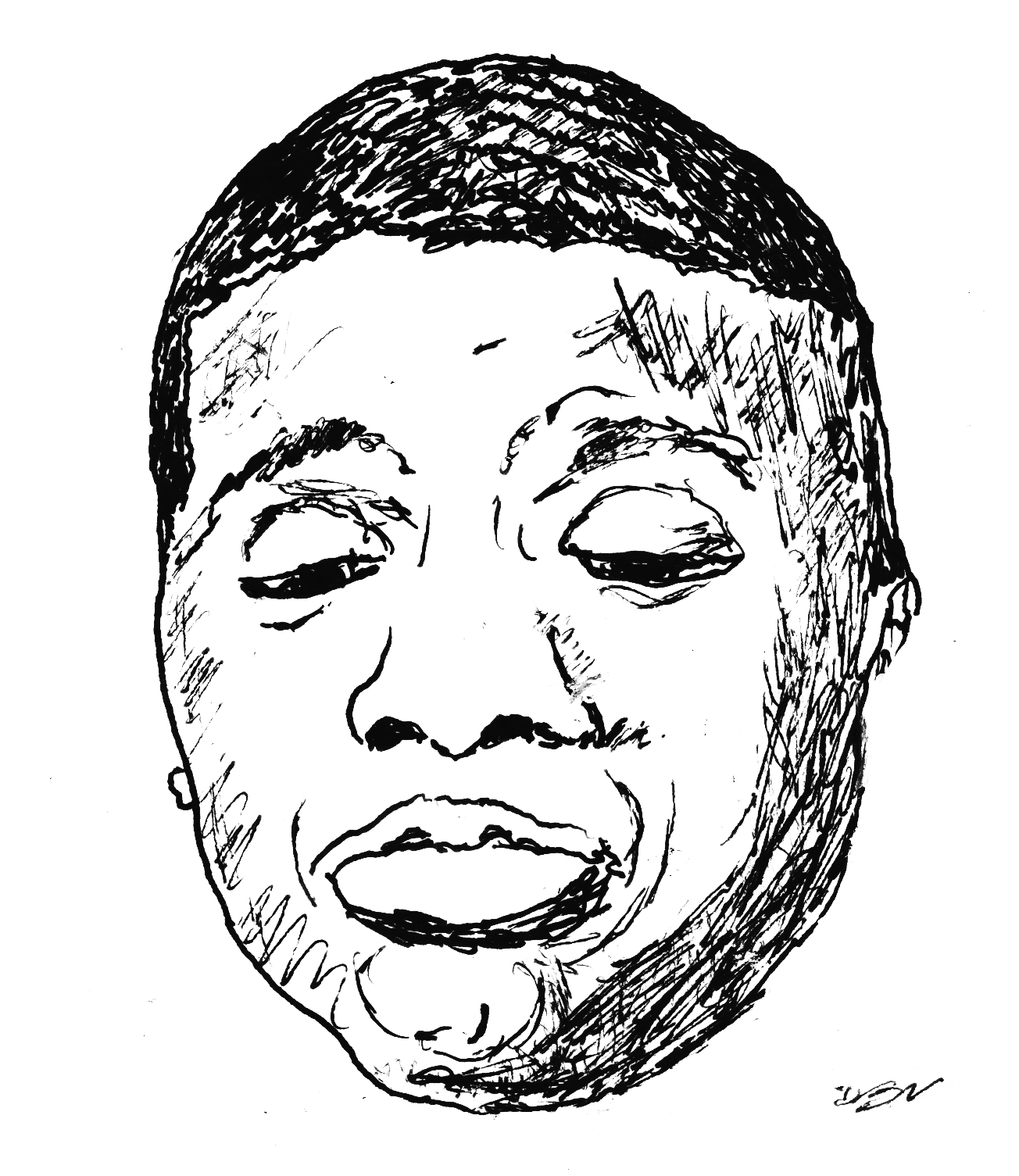 September 12, 2025:
MIKE CLARK JR.: Keep On Steppin: Big Stepper Edition (ColliPark Music/Atlantic) Five Stars ***** Can't miss. Pure Southern Soul heaven.
Buy Mike Clark Jr.'s new Keep On Steppin: Big Stepper Edition at Apple.
KEEP ON STEPPIN': BIG STEPPER EDITION Track List:
1. Mistreated (feat. Boozie Badazz & Anthony Q.
2. Keep On Steppin' (feat. Big Boogie)
3. Worry You (feat. 803Fresh)
4. Pop That
5. Trail Ride (feat. Bun B. & Jeter Jones)
6. Auntie Outside (Collipark Remix)
7. Stay Right There (feat. Big Bo)
8. Break Up Letter (feat. Marcellus The Singer)
9. Dog House
10. Treasure
11. Keep On Steppin'
Exactly two years ago, September of 2023, Mike Clark Jr. burst upon the southern soul scene with
"Auntie Outside Tonight". Almost forgotten now,
"Auntie Outside" was an anthem. You could feel the excitement and hormones pumping through its verses. It had the makings of one of those energetic R&B/pop hybrids that become arena "jock jams," and it was southern soul all the way, elevating yet another new black slang term ("aunties") into the national lexicon. "Auntie Outside" rose to
number one and his southern soul debut EP
Club Mike Clark soon appeared. Still, I hadn't a clue Mike Clark Jr. would soon back up "Auntie" with even more astounding music.
But that's what Mike did. Another Top 10 Single,
"Party," accompanied by E. Realist & Charity Harris, arrived that December. Another Top 10-charting tune,
"Doghouse," followed in September of 2024.
"Slow Roll It," an accomplished cover of the
Love Doctor's seminal southern soul classic, charted in December of '24. Then---in 2025---came the "bomb" that would change the trajectory of Clark Jr.'s career from successful to legendary. But it wasn't easy.
"Keep On Steppin'" had the misfortune of debuting at almost the same time as 803Fresh's
"Boots On The Ground," which had dropped and charted at #5 a month earlier. So in March of 2025 the viral "Boots On The Ground," which had practically everyone in the country---including the former first lady Michelle Obama---line-dancing to it, occupied the #1 Single spot, while Mike Clark Jr.'s "Keep On Steppin'" had to be content with the
"#2 Single spot. Yet even then, at the height of the clamor for "Boots On The Ground" (including your Daddy B. Nice proclaiming it "the biggest phenomenon to hit southern soul music since King George's "Keep On Rollin'"), I was enjoying Mike Clark Jr.'s "Keep On Steppin'" just a little bit more. And with "Keep On Steppin'" trending throughout southern soul fandom in burgeoning numbers, I had no qualms in finally justifying its #1 game-of-southern-soul-thrones ranking in
April of 2025. Huge. Eventful. A career-maker.
Published just two weeks ago, Clark Jr.'s new, eleven-track LP
Keep On Steppin: Big Stepper Edition is a celebration of all things "keep-on-steppin". The fact the collection not only covers the mega-hit's iterations and other recorded singles (the danceable "Pop That," overlooked because it came out almost like a "B-side" at the same time as "Steppin'," the previously mentioned "Auntie Outside" and "Dog House," and two impressive, new, September-charting singles, "Break Up Letter" featuring Marcellus The Singer and "Worry You" featuring 803Fresh) has to make it a no-brainer for the trail ride, backyard barbeque and hole-in-the-wall, party album of the year.
And yet, as many people as "Keep On Steppin'" has drawn to the dance floor, and as many TikTok shorts and YouTube videos as it's spawned, little to nothing has been written about its memorable instrumental track. In my
bullet commentary in March introducing "Keep On Steppin'" to the audience for the first time, I described the uniquely textured background to Mike's viral vocal in this way:
"It sounds like an entire army on the march. The vaguely military percussive effects---stomp, stomp, stomp, stomp---and hypnotic beat will stun you, and if you've got a dancing bone in your body you'll find it impossible not to jump on the dance floor and keep on steppin'."
Today I might describe it as layers upon layers of hand-claps, but "hand-clapping' doesn't do it justice. There have been some super-hot and innovative southern soul producers in the last decade---Beat Flippa (Pokey Bear), Slack (Jeter Jones) and Kang803 (King George) instantly come to mind---but to that list we must now add Mr. Collipark, Atlanta-based Michael Antoine Crooms, who took his industry name from the Atlanta suburb of College Park. Collipark is just as incredible, but with an entirely new and unique sound. Mostly working in hiphop, Collipark was the producer of V.I.C.'s
"Wobble". For those too young to remember, this song was big in the Dirty South in the late aughts and early teens, even on southern soul radio and especially in the clubs, and it was two or three years before it became national and made the Billboard charts. Interestingly enough, like its 2025 counterparts, "Wobble" grew in popularity after inspiring a dance.
"Wobble" was all about the instrumental track, hugely percussive, with a wild upper melody line played by horns. Similarly, the forgotten and under-appreciated part of "Keep On Steppin'" is the respite from the stomping---the choruses! Signaled by a whistle, it's also a higher-pitched, anthem-like melody line---all humming---rendered by Mike Clark Jr. in eloquent contrast to his style in the verses, giving the song's powerful chant an eerie, unforgettable resonance.
And there's one last aspect of "Keep On Steppin'" that deserves testimony. The key words in the lyrics---the ones no one thinks about---are
"They don't like it". It's an emblem for adversity, whether it be in one's job, one's health, one's social interactions or whatever. Anything in the world that puts shackles on one's spirit. So when you start steppin', you're saying, "No, I won't quit! I won't give up!"
---Daddy B. Nice
Buy Mike Clark Jr.'s new Keep On Steppin: Big Stepper Edition at Apple.
Listen to all the tracks from Mike Clark Jr.'s new Keep On Steppin: Big Stepper Edition album on YouTube.
Read Daddy B. Nice's Southern Soul The New Generation Artist Guide to Mike Clark Jr.
************
Send product to:
SouthernSoulRnB.com
P.O. Box 19574
Boulder, Colorado 80308
Or e-Mail:
daddybnice@southernsoulrnb.com
*************
August 17, 2025:TUCKA: Hit Nation Compilation Volume 1
Five Stars ***** Can't miss. Pure Southern Soul heaven.
Buy Tucka's new The Hit Nation Compilation at Apple.
HIT NATION COMPILATION VOL. 1 Track List:
1. King Of Hearts (Intro) --- Mike Bolden/House Of Grooves
2. Boogie Boots --- Shelton Richardson
3. Trail Ride Blues --- Terry Rogers
4. Pull Up --- Nino The Gentleman
5. One Night --- Nino The Gentleman
6. Last Time --- Mr. Mister
7. Trouble --- Mr. Mister
8. Gypsy Blues --- Terry Rogers feat. Jubu Smith
9. She Loves Me --- Mr. Hot Topic feat. Tucka
10. Come On Baby --- Mr. Smoke
11. Stop, Drop & Roll It --- Mr. Smoke feat. FPG
12. Walk That Walk --- T-Man
This mint-new sampler from Tucka's Hit Nation label begins with a teaser, an instrumental track by Mike Bolden called
"King Of Hearts," as stunning in its "thrill-is-gone-ish" musicality as in its stubborn wordlessness. Glimmers of
"Jukebox Lover" may flit before your eyes, and you may be thinking, "This is too good not to be fleshed-out with lyrics!" And you may wait, anticipating Tucka's patented, heavy-velvet, vocal accompaniment. After all, he couldn't resist, could he? Well...Yes. He could.
The album's second track comes at you like a Shohei Ohtani change-up. Shelton Richardson's
"Boogie Boots" is a hoot---a vintage funk curveball so cheeky and self-absorbed you can't compute it being in the same queue with "King Of Hearts". But there it is...
Tucka James Presents The Hit Nation Compilation Volume 1 is not for the timid of heart. And if you've already been honed down to near-simpleton status by your personal algorithms, be warned. In the Hit Nation world there's a surprise around every bend.
Such as the third selection, a sophisticated blues by Terry Rogers called
"Trail Ride Blues," that couldn't be more different from either of the opening two tracks. In other words, this is a "sampler" in the truest sense of the word: a myriad of performers and styles. And this sampler, coming off the recent appearance of Kang803's EP
New School Blues, harks back to the days when compilations were a steady musical diet. The seminal John Ward's decades of Ecko samplers were the best (though in recent years, as the musical content atrophied, the samplers lost some of their luster), and in later days Dylann DeAnna's shorter-lived CDS label's compilations became as ubiquitous as yesteryear drugstore racks of "greatest hits". But ever since the Covid era, samplers and compilations have become nearly extinct. And that is why, despite its flaws, this new project from Tucka beckons like an oasis in the Sahara.
After weathering the anti-algorithmic shocks of the opening tunes, the album does settle down into a fairly straightforward presentation of new and aspiring recording artists, each gifted a pair of selections. The bluesy Terry Rogers is represented by the previously mentioned "Trail Ride Blues" and the equally skillful
"Gypsy Blues" featuring Jubu Smith. Nino The Gentleman is represented by the already trending
"Pull Up (On Me)" and "One Night," while Mr. Mister (yes, that's his name) checks in with the robust ballad
"Last Time" and "Trouble". The raw-throated Mr. Smoke, who really isn't "new" but could accurately be described as "aspiring," is represented by two tracks that build upon old classics "Rocking Chair" (Gwen McRae) and "Stop, Drop & Roll" (La'Keisha), the first titled
"Come On Baby" and the second
"Stop Drop And Roll It". FPJ guests on the latter.
It's no secret that Tucka, like his respected colleague King George, has simplified ("dumbed-down" would be too cruel a word) his newer music, eschewing the spectacular presentations of his fan-winning, early career in favor of two-and-three-chord hooks that more often than not fall short of the primal gold 803Fresh was blessed enough to tap into with the viral "Boots On The Ground". Tucka's also gained weight---something I noticed while watching a podcast of one of his recent concerts. His head is wider. He's looking and acting like a grown man---dare I say middle-aged? In the aforementioned concert, he pauses without blinking, staring at the audience, and the pause continues long enough to make a point, as if he's waiting for some missing respect, obeisance or validation. It's something only a mature man, thoroughly confident in his skill and status, could muster.
I bring this up because of the sampler's two remaining tracks, T-Man's "Walk That Walk" and Mr. Hot Topic's
"She Loves Me (She Love Me Not)," Tucka appears on the latter. It's his only appearance of the entire compilation, and he takes over the song like a plundering conqueror. Although Mr. Hot Topic provides the key---the opportunity---it's Tucka who seizes on its nursery-rhyme simplicity and transforms it into a Tucka classic, the very southern soul nirvana he's been seeking with his own tunes like "Make It Roll".
---Daddy B. Nice
Listen to all the tracks from Tucka's Hit Nation Compilation on YouTube.
Buy Tucka's The Hit Nation Compilation at Apple.
Read Daddy B. Nice's Artist Guide to Tucka: The New Generation Southern Soul:
#2 ranked Southern Soul Artist.
************
Send product to:
SouthernSoulRnB.com
P.O. Box 19574
Boulder, Colorado 80308
Or e-Mail:
daddybnice@southernsoulrnb.com
*************
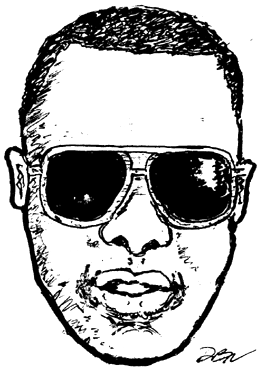 July 27, 2025:
FAT DADDY: Perfect
Five Stars ***** Can't miss. Pure Southern Soul heaven.
Buy Fat Daddy's new PERFECT EP at Apple.
PERFECT Track List:
1. Got My Money Right
2. Thick Like 40 Weight Gravy
3. Perfect (feat. FPJ)
4. License To Steal
5. Good Vibes Only
6. I'm Him
Like Paul Atreides in the movie "Dune," the dreamer--Fat Daddy--has awakened. There is no musically measurable reason Arthur Young, for example, should have published a half-dozen albums in roughly the same span of time in which Fat Daddy has whiffed, recording only a similar number of singles. Yes, it's been six years since F.D.'s impressive 2019 debut album,
Fat Daddy Gonna Love You Right. And while Arthur Young has exhibited the superior compositional genius and boasts a burgeoning catalog of worthy material, the two up-and-coming stars share the same powerful tenors and mahogany richness of tone. Moreover, as his new EP
Perfect attests, Fat Daddy actually has the edge when it comes to the clarity, contrasts and panoramic scope of his vocals.
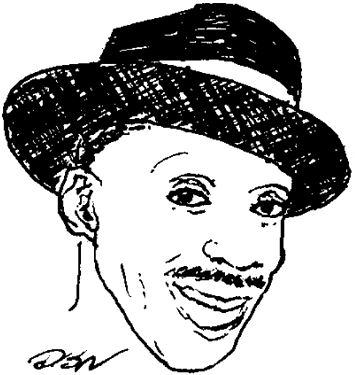
If you've ever listened to Fat Daddy singing
"Mr. Nobody," his clone of Johnnie Taylor's
"Mr. Nobody Is Somebody Now," you know that even Johnnie's son T.J. Hooker Taylor, who makes a living doing tributes to the godfather of southern soul, can't approach the eerie resemblance in vocal quality Fat Daddy shares with Johnnie. And then there's Fat Daddy's relationship with Tucka. They have a special bond (they're said to be related) and often tour together. But hanging out with a star of Tucka's magnitude and profiting from the celebrity access, albeit a choice any aspiring musician would be reluctant to forgo, could also explain some of Fat Daddy's inattentiveness to the progress of his own career.
Fat Daddy (who by the way is not "fat") is the performance name of Allen Turner, the son of blues legend R.L. Griffin, longtime owner of R.L.'s Blues Palace in Dallas, Texas. He first emerged with "The Blame,"
Daddy B. Nice's Best Debut of 2018, an outstanding southern soul anthem with a vintage-quality melody, a head-swiveling lead vocal, a sublime female chorus and a classic instrumental track. Fat Daddy's done some crazy stuff in his career, among other things kidnapping Jesse Graham's single
"Mr. Mailman," instrumental track and all, and recording it as
"Strong Woman," then turning around and recording an entirely new song called
"Mail Man,"
In any case,
Perfect is an eye-opening reminder of Fat Daddy's under-utilized talent only waiting to be tapped.
"Got My Money Right," the opening track, was a #4-ranked single on Daddy B. Nice's Top 10 for July 2025.
"License To Steal" is an exemplary cover of a not-well-known classic previously recorded by Clay Hammond and Vernon Garrett. The least original track on the set, ironically, is the title track,
"Perfect". It's a threadbare melody and beat reminiscent of projects Fat Daddy has done with Tucka. Even guest artist FPJ's contribution seems unenthusiastic, not to mention woefully buried in the instrumental mix.
But the vibrant
"I'm Him" and the gently-rocking
"Good Vibes Only" more than make up for this solitary lapse. The sleeper of this EP---so daring, I suspect, that Fat Daddy himself is unsure and wary of its value---is the deftly-produced
"Thick Like 40 Weight Gravy". With a scintillating acoustic guitar accompaniment, the song offers Fat Daddy plenty of space to take wing and soar, vocally speaking. And Fat Daddy can be rousing with such ease. It's a revelation of what marvelous paths to musical self-fulfillment beckon this performer if he only gains confidence and gets into the studio and works.
---Daddy B. Nice
Read Daddy B. Nice's Artist Guide to Fat Daddy.
************
Send product to:
SouthernSoulRnB.com
P.O. Box 19574
Boulder, Colorado 80308
Or e-Mail:
daddybnice@southernsoulrnb.com
*************
UNDER CONSTRUCTION!!! UNDER CONSTANT REVISION!!!